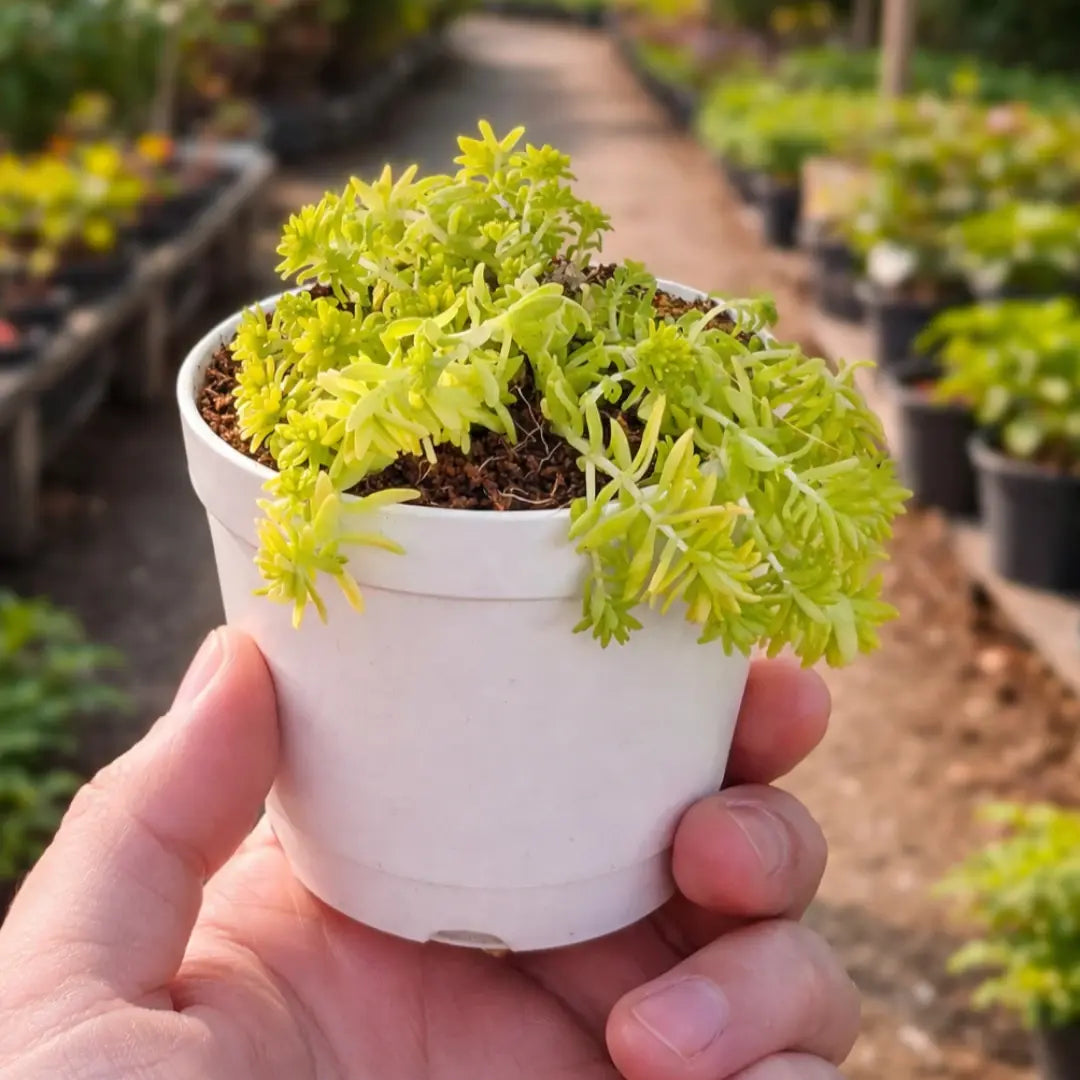
Sedum japonicum 'Tokyo Sun' (Golden Japanese Stonecrop)
Description
Sedum japonicum 'Tokyo Sun' is a slow, spreading groundcover that is best loved for its colourful foliage which needs direct sun to maintain its cheerful golden hue, sometimes with orange or amber accents during hot and cold extremes. Like many of the smaller stonecrops, Sedum japonicum ‘Tokyo Sun’ does not stand erect, instead spreading into a thick, needle-covered mat – perfect for the front of border rock gardens, shallow dishes of succulents, or for interplanting between more green-foliaged plants.
Sedums enjoy sunny window ledges, patios or balconies as long as they can receive many hours of sunlight a day (the more sun the better to enhance the stunning golden tones). When grown indoors, place it on a light-filled sill but be aware that the colour won’t be as vibrant and the growth habit can become more relaxed in poor light. Great used as a filler plant in succulent arrangements or bowls, grown alongside other sedums and echeverias, or alone in a small pot where its textural spread can be observed. Drought tolerant and small, it's an easy option for those starting their succulent collections who are looking for some color and beauty without a lot of effort.
The Japanese sedum, ‘Tokyo Sun’ is a wonderful plant for bringing a pop of golden light to a succulent collection, it puts up with poor watering for more than any other house plant and looks just as nice sitting alone as it does with several small succulents growing together in a shared planter.
Key Features
- Golden yellow to chartreuse in spring, deepen into amber or orange in cool weather and intense sun.
- Spreading and mounding, habit low growing is suited to rock gardens, succulent bowls.
- Needle like tightly packed leaves.
- Smaller plants with smaller, needle-like leaves bring texture to larger-leaved plants like succulents.
- A super easy, low-maintenance succulent for windowsills, balconies and anywhere else there’s sun!
- Color intensity is an indication of needed light exposure.
- Easily prop. From cuttings. Drought tolerant after establishment .
Care at a Glance
|
Care Aspect
|
Requirement
|
|
Sunlight
|
Full sun to bright light; at least 4-6 hours daily for best colour
|
|
Watering
|
Water deeply but less frequently. Permit the soil to dry out completely between irrigations.
|
|
Temperature
|
10°C to 27°C; protect from prolonged frost and heavy monsoon dampness
|
|
Humidity
|
Low to moderate humidity preferred; good circulation helps prevent rot
|
|
Repotting
|
Every 1-2 years, or once the mat outgrows its pot, ideally in spring
|
|
Growth Rate
|
Moderate; spreads steadily outward once settled in bright light
|
Product Specifications
|
Specification
|
Details
|
|
Plant Common Name
|
Golden Japanese Stonecrop
|
|
Botanical Name
|
Sedum japonicum 'Tokyo Sun'
|
|
Plant Type
|
Succulent; groundcover
|
|
Life Cycle
|
Perennial
|
|
Suitable Location
|
Sunny window sills, balconies, patios, rock gardens
|
|
Sunlight Exposure
|
Full sun to bright light
|
|
Bloom Period
|
Occasional small star-shaped yellow flowers in warmer months
|
|
Special Features
|
Golden foliage that deepens in colour with sun and cooler weather; drought tolerant
|
|
Plant Size at Dispatch
|
Approx. 3 inches, low spreading mat
|
|
Bare-rooted / Pot
|
Optional
|
|
Pot Size
|
3 inches
|
|
Pot Material
|
Plastic nursery pot
|
|
Soil Type
|
Well-draining succulent/cactus mix
|
|
Country of Origin
|
India
|
|
Brand
|
Plant Orbit
|
|
Seller
|
Plant Orbit Haldwani
|
What's in the Box
- 1 × Live Sedum japonicum 'Tokyo Sun' plant
- 1 × Nursery pot (Bare-rooted / Pot: Optional)
- Well-draining succulent potting mix
- Care guide
Important Notes
- Colour can vary – your plant may be greener or more golden than pictured, depending on where it has grown in the past
- Colour becomes more pronounced in sun and cold (golden, orangey, reddish) – plant is greener when grown in shade
- You may experience some leaf softening or a few lost leaves after transit – give your plant 1-2 weeks to acclimatize before watering again.
- Don’t over water – water thoroughly, and then don’t water again until the soil is dry. Roots rot easily if allowed to sit in wet soil.
- Plants may show sun spots if moved into very bright direct sun quickly after being indoors. Introduce your plant to the sun gradually.
- Plant grows less in winter months and when light levels are lower
Frequently Asked Questions
Q: My Sedum ‘Tokyo Sun’ has gone green. Why?
A: The colour of this Sedum is quite dependent on light. With lower levels of light, it will try and get more of its green pigment and fade a bit of the golden amber hue. It should soon turn richer in colour over a few weeks if it is relocated to a spot that receives several hours of direct, or bright light each day.
Q: How much water does this plant require?
A: Water it when the soil is fully dried and water till it starts draining from the drainage holes. Under most conditions in India, this averages to once every 1 to 2 weeks; it will be even lesser in cool/humid climatic conditions.
Q: Can I grow sedum japonicum Tokyo Sun indoors?
A: It will exist indoors on a well-lit, sunny windowsill but will get the best colour and grow more compactly if positioned outside or in a position that receives direct sunlight for a minimum of part of the day. If used indoors and given less light, you will notice greener, less tightly grown, more lanky specimens.
Q: How much sun does this sedum need?
A: It should have 4 to 6 hours a day of bright or direct sun. The more sun it gets, the deeper the rich gold-orange color; the less sun it gets, the paleness and stretch with greener leaves.
Q: What is the growing speed and spread of Sedum ‘Tokyo Sun’?
A: It is an average growing succulent which spreads out horizontally, forming a mat once it has a good set in the pot or planting place. In due time, it can even fill up empty spaces of your succulent bowl or rockery.
Q: Should I re-pot or propagate this sedum?
A: Re-pot every 1-2 years or as soon as it looks like the mat is overgrown for its current container using a new succulent well-draining mix. Cuttings can be made from small stem cuttings, let the ends dry and callus over for 1-2 days and then lay on top of moist soil to form roots.