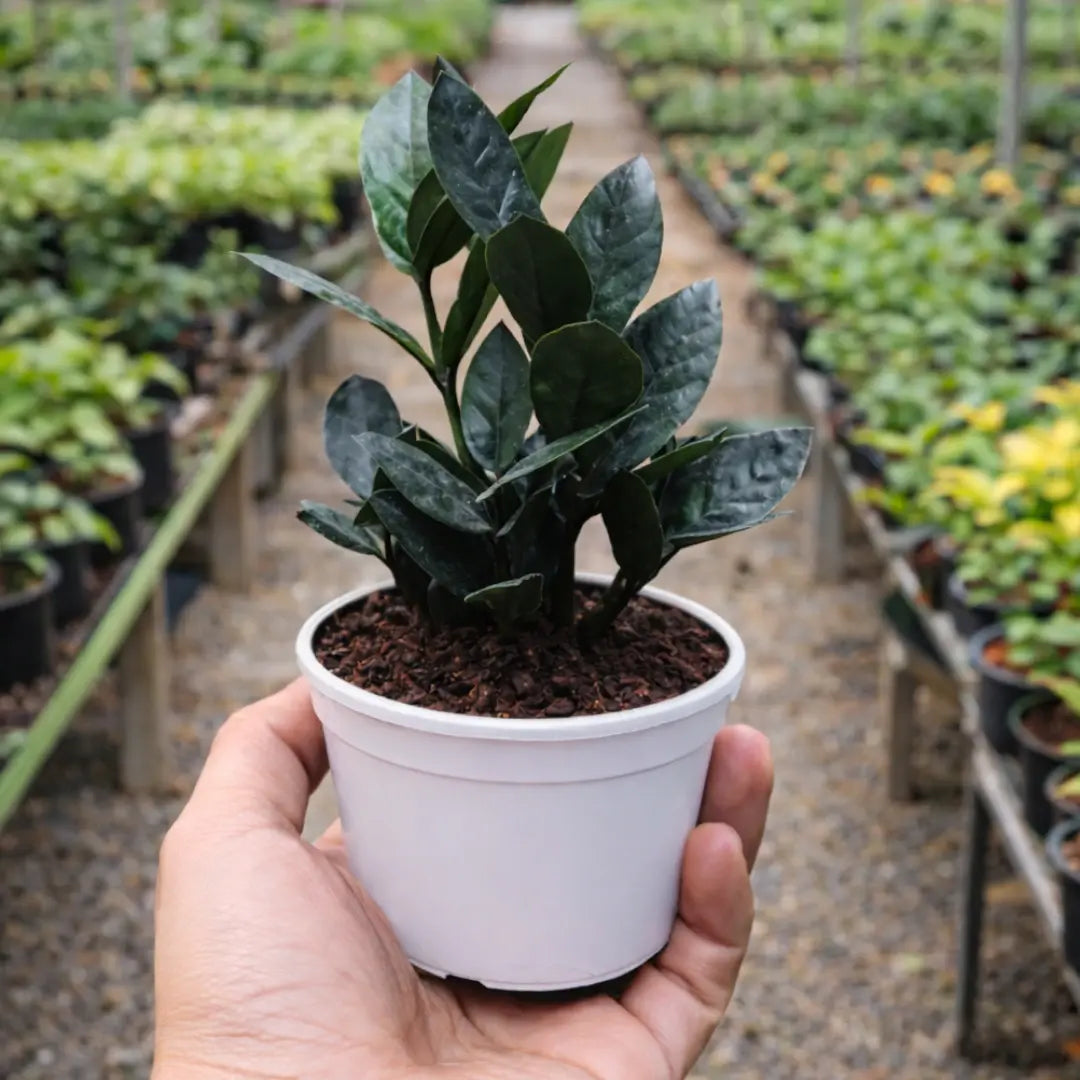
ZZ Plant (Black Zamiya Air purifying Plant)
✅ Exclusive Bonus Offer just for you!
🎁 Get 5% OFF automatically on orders above ₹599
📦 Easy Returns – Compulsory Unboxing Video
Couldn't load pickup availability
How we work!
How we work!
Add a touch of green to your home/office in three simple steps and become a plant parent.
Plants,
simplified: Order plants ready to be placed in your home, office or
garden. Just Unpack, Relax and Enjoy your green buddies
Secure
Shipping: Our unique packaging will hold the plants in place and let the
plant breathe so that it reaches you fresh without any mess.
Detailed
Guidance: Get detailed plant care instructions from the website as well
as real-time guidance from our Garden Experts on Whatsapp.
Care Tips
Care Tips
1. After recieveing the plants open the box 📦 as soon as possible .
2. Air dry the plants for 2-3 hours on fresh air .
3. Plant in well drained soil . ( 30%sand + 30% soil + 20% vermicompost + 20% perlite ) .
4. Water plants after 2-3 days and don’t give direct sunlight to newly planted succulents for at least 10 days .
Note: Always water succulents when top layer of soil feels dry in roots of plant rather than leaves .
Shipping
Shipping
Plants without pots will be sent bare rooted. Free delievery above Rs 249 .
Refund Policy
Refund Policy
We have a 2-3 days return policy, which means you have 2-3 days after receiving your item to request a return or replacement.
Description
Description
ZZ Plant – Black Zamioculcas (Zamioculcas zamiifolia ‘Raven’)
Description
The Black ZZ Plant is the named cultivar of Zamioculcas zamiifolia 'Raven'. A popular variety of this houseplant, known for its glossy, practically succulent-like leaves, it starts off growing leaves that are a light lime green, before darkening gradually over a few weeks into a deep purple-black as they mature (hence the 'Raven' name). As this isn't a naturally growing species but a cultivar (cultivated variety) that has been selectively bred, it's genetically identical to the species Zamioculcas zamiifolia and comes from the same original species which native to eastern Africa's dry, rocky areas.
Both new and established indoor gardeners alike love this plant for just how undemanding it is. This houseplant grows from the thick, potato-like underground rhizomes from which it stores its water, which makes it more tolerant of being under or over-watered than many other common houseplant types. The architectural, upright growing habit and the very dark foliage make it a stark accent piece rather than being a plant to blend into the background and the colour is often selected for modern/minimalist interiors in order to stand out against a lighter background.
This ZZ plant tolerates a variety of light conditions ranging from low-light corners right through to bright, indirectly lit positions which make it a particularly versatile choice for offices, hallways, and even rooms lacking sunlight. With that said however, light colouration appears deepest, and the plant's growth is slightly increased, with bright indirect light; direct, full sunlight should be avoided however to prevent leaves scorching or the pigment from fading. This plant has been claimed, along with several other foliage houseplants, to be 'air purifying'. This claim is made based on the results of many experiments and studies conducted under controlled conditions on foliage plants, but the amount of pollutants actually removed from a room by one plant is likely to be minimal.
Key Features
- Glossy, deep purple-black foliage maturing from young, lime-green new growth
- A succulent that can store water in its thick underground rhizomes. Tolerates irregular watering.
- Thrives equally in both low and bright, indirect light conditions, therefore is excellent in an office environment or dark corner.
- Slow, upright growth habit with minimal need for pruning
- Naturally drought-tolerant once established
- Distinctive dark foliage that works well as a standalone accent plant
- Generally low-maintenance, suiting busy households and offices
- Though normally associated with the betterment of indoor air quality, its effect in a typical room is insignificant
Care at a Glance
|
Aspect |
Requirement |
|
Sunlight |
Low to bright indirect light; avoid direct, harsh sun |
|
Watering |
Water only when the soil has dried completely – roughly every 2-3 weeks |
|
Temperature |
16°C to 24°C; not frost-hardy, avoid cold drafts |
|
Humidity |
Average room humidity is sufficient; no special humidity needs |
|
Repotting |
Every 2–3 years, as the rhizomes are slow to outgrow their pot |
|
Growth rate |
Slow |
Product Specifications
|
Specification |
Detail |
|
Plant common name |
Black ZZ Plant / Raven ZZ Plant |
|
Botanical name |
Zamioculcas zamiifolia ‘Raven’ |
|
Plant type |
Indoor foliage plant; air-purifying |
|
Life cycle |
Perennial |
|
Suitable location |
Indoor; low to bright indirect light areas |
|
Sunlight exposure |
Low to bright, indirect light |
|
Bloom period |
Rarely flowers indoors; grown primarily for foliage |
|
Special features |
Glossy dark purple-black leaves; drought-tolerant rhizomes |
|
Plant size at dispatch |
3 inches |
|
Bare-rooted/Pot |
Optional |
|
Pot size |
3 inches |
|
Pot material |
Plastic |
|
Soil type |
Well-draining potting mix |
|
Country of origin |
India |
|
Brand |
Plant Orbit |
|
Item weight |
Varies by pot and soil moisture |
|
Package dimensions |
Varies based on plant size at time of dispatch |
|
Seller |
Plant Orbit Haldawni |
What’s in the Box
- 1 × Live Black ZZ Plant (Zamioculcas zamiifolia ‘Raven’)
- 1 × Pot (Bare-rooted / Pot: Optional)
- Potting mix
- Care guide
Important Notes
- Fresh leaves will appear light green in color and in time over a few weeks they will turn purple-black this is a natural occurrence in the plant and it does not show that it is distressed in any way.
- A bit of leaf drop or slight wilting is not uncommon after shipping, but should subside within a week or two as the plant acclimates to the new surroundings.
- Do not let this plant have direct bright light as the leaves can get burnt by the sun and the dark color may turn light or even bleached out by the sun's rays.
- This plant contains calcium oxalate crystals and will be fatal if eaten, so make sure to keep it away from pets and small children.
- Overwatering is the most frequent problem with this plant; the soil should be completely dried out between waterings; this is more important in winter.
- Be careful with the rhizomes during re-potting as they are fleshy and can bruise.
Frequently Asked Questions
Q: Why are the leaves on my plant still green instead of black?
A: The new growth on this plant always appears a bright green, and gradually becomes darker purple-black over a couple of weeks as the leaf ages. This is completely normal, so new leaves will often have a different colour to older ones on the plant simultaneously.
Q: How often should I water this plant?
A: Don't water again until the soil has totally dried out (about every 2-3 weeks, more rarely in winter). This plant holds its water in its subterranean rhizomes, making it much more susceptible to drought than to overwatering.
Q: Can this plant survive in a low-light room?
A: Yes, this is one of the low-light tolerant plants out there and can thrive in darker corners of the room or room with little direct light, although dark color is a bit more pronounced and it grows a little faster in indirect light.
Q: Is this plant safe to keep around pets and children?
A: Calcium oxalate crystals are present in the plant and irritation will occur if it is chewed and eaten. It is poisonous if ingested by animals or humans and should be kept out of reach of inquisitive pets and young children.
Q: How fast does this plant grow, and will it need repotting often?
A: It is a relatively slow growing plant and is not one which requires frequent repotting. Every 2 to 3 years or when the rhizomes have taken up a good portion of the pot will usually suffice.
Q: Does this plant actually purify the air?
A: In a few studies on foliage plants, like the ZZ plant, absorption of tiny amounts of specific airborne compounds was demonstrated under laboratory conditions. The impact in an average home or office would not be expected to be significant, but likely would be, so not one upon which to bet as a replacement for adequate ventilation.