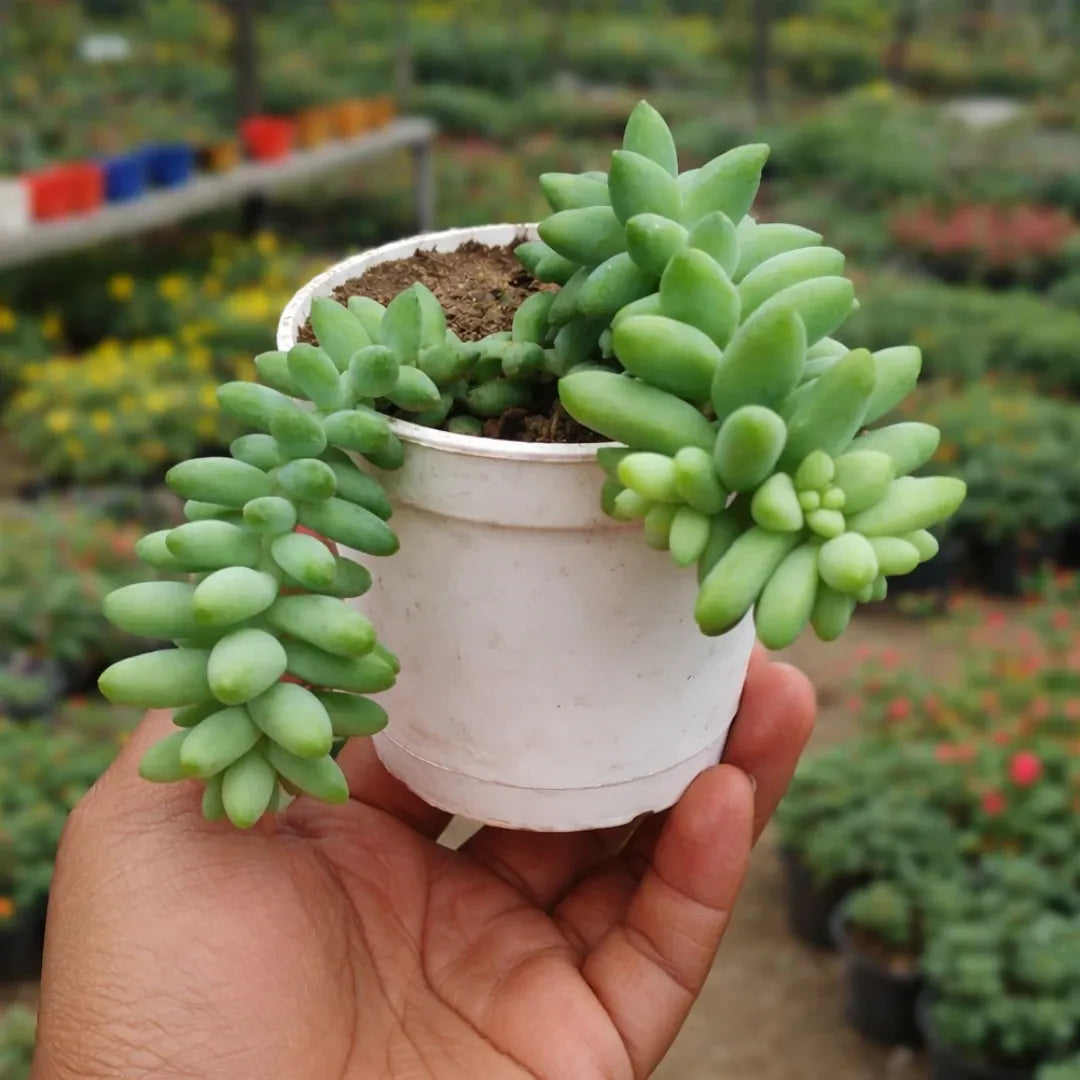
Burro's Tail (Sedum morganianum | Donkey's Tail | Lamb's Tail)
Description
Burro's Tail Sedum morganianum, the botanical name of Burro's Tail is another succulent which can be found in the rocks and arid regions of Southern Mexico as well as Honduras. It is often referred to as donkey tail or lambs tail due to its long trailing stems, which are closely set with the well-defined teardrop-shape leaves to form a tightly woven, braided structure. The blue-green leaves have a bloom which may wear off easily with handling, creating a unique, frost like surface. It has been described as being, "long and leathery" or that "long stems droop downward, it is an exceptional trailing plant."
This Burro's Tail plant is ideal for those looking for a succulent that will require minimal care and will have lots of visual appeal. The leaves of this plant have the ability to store water, allowing the plant to survive long periods without watering, which means that it is less demanding than other house plants when it comes to top-ups. The Burro’s Tail thrives on balconies that get plenty of sunlight; you can grow it on a balcony railing, on a sunny windowsill or hanging near the window where there is sunlight for several hours during the day.
With a simple to maintain regimen, you only need to have adequate light and drainage, making them a wonderful entry point if you’re interested in more structurally interesting options than a standard houseplant. Burro’s Tail may hang off a railing, drape down over an office desk, or fall over the edges of a plant shelf.
Key Features
- The stems can trail for a long time, and the leaves are thick, chubby and tear-dropped, creating a plait-effect.
- The stem has soft, pale-green, blue tinged leaves with a fine silvery bloom giving a frosty effect to the plant.
- It is extremely draught resistant due to its plump water storing leaves and is best left un-watered for periods.
- Almost zero maintenance – a great plant for anyone just starting out in the plant world, or those with busy schedules.
- The long, hanging stems make it a fantastic choice for hanging plants and shelves.
- Slow growing so will keep its shape year on year, only requiring the odd bit of trimming.
- Easy to propagate a whole new succulent from a single leaf and/or cutting.
- The quirky, sculpturally look makes a unique present for someone who loves succulents.
Care at a Glance
|
Sunlight
|
Bright light with a few hours of gentle direct or filtered morning sun daily; avoid harsh midday sun
|
|
Watering
|
Allow the soil to dry out completely between waterings, roughly every 2-3 weeks in the growing season and less in winter
|
|
Temperature
|
Prefers warm conditions, roughly 18°C to 27°C; not frost-tolerant, so protect from cold drafts and winter chill
|
|
Humidity
|
Adapts well to normal room humidity; low humidity is preferred over damp, humid conditions
|
|
Repotting
|
Repot only every few years, as this plant does well when slightly root-bound; use a well-draining succulent mix
|
|
Growth Rate
|
Slow to moderate, with stems gradually lengthening over the growing season and little change in winter
|
Product Specifications
|
Plant Common Name
|
Burro's Tail / Donkey's Tail / Lamb's Tail
|
|
Botanical Name
|
Sedum morganianum
|
|
Plant Type
|
Trailing Succulent
|
|
Life Cycle
|
Perennial
|
|
Suitable Location
|
Balconies, hanging planters, bright windowsills, shelves
|
|
Sunlight Exposure
|
Bright light with some gentle direct or filtered sun
|
|
Bloom Period
|
Rarely flowers indoors; occasional pink to reddish blooms in summer under ideal conditions
|
|
Special Features
|
Braided trailing stems, drought tolerant, distinctive blue-green foliage
|
|
Plant Size at Dispatch
|
Approximately 3 inches
|
|
Bare-rooted / Pot
|
Optional
|
|
Pot Size
|
3-inch nursery pot
|
|
Pot Material
|
Plastic
|
|
Soil Type
|
Well-draining potting mix
|
|
Country of Origin
|
India
|
|
Brand
|
Plant Orbit
|
|
Seller
|
Plant Orbit, Haldwani
|
What's in the Box
- 1 x Live Burro's Tail (Sedum morganianum) plant
- 1 × Nursery pot (Bare-rooted / Pot: Optional)
- Well-draining potting mix
- Basic care instructions
Important Notes
- As it is a natural product each plant will vary in leaf length, density and colour slightly.
- The leaves fall off very easily when handled or brushed past so be gentle with the plant and handle carefully while unboxing.
- Natural leaf drop will occur during transit and is not harmful to the plant; it should start to settle down after 1-2 weeks.
- Gradually move your plant into full sun-don’t put it in harsh direct sun immediately after it has been transported.
- Never ever water the soil logged in Burro’s Tail much more intolerant of wet soils.
- Place your plant out of the reach of small kids and animals who might enjoy chomping on the delicate leaves of this house plant, just to be on the safe side.
Frequently Asked Questions
Q: Why is my Burro’s tail shedding its leaves?
A: In some cases, leaf drop is totally normal because the leaves connect loosely to the stem and easily detach from accidental touching or even from being bumped. For the best results, plant your Burro’s tail where it will not be disturbed, moved around or easily handled.
Q: What should I do for this plant when it comes to watering?
A: Water the Burro’s tail about every two to three weeks during the growing season and a lot less during the dormant season. Ensure the soil is dry before watering because watering too often will only cause more issues.
Q: Can Burro’s Tail be grown indoors?
A: It can, if it has access to a very sunny location-preferably a south- or west-facing window. Otherwise, stems tend to stretch with wide spacing between leaves and a loss of its characteristic compact, braided form.
Q: Is Burro’s Tail toxic to pets?
A: Most sources agree that Burro’s Tail is non-toxic to cats, dogs and people, although eating a very large quantity might still cause mild stomach upset for a few. In any case, it’s a good idea to keep any houseplant out of the reach of small children and inquisitive animals.
Q: My plant’s base looks discolored or mushy. What should I do?
A: This is almost always caused by overwatering or insufficient drainage. This will lead to your plant to have stem and or root rot. Allow your plant to completely dry out, then you should trim off any of the mushy areas and then stop watering your plant for a bit and only start again when you see indications of revival.
Q: How do I go about propagating Burro's Tail?
A: To start a Burro's Tail you’ll simply take a whole leaf and a couple inch stem, and then allow the ends to dry and callous over for 2-3 days and lay that leaf flat on top of some well-draining soil, and keep it very lightly watered without disturbing. It should start producing roots in a few weeks.