
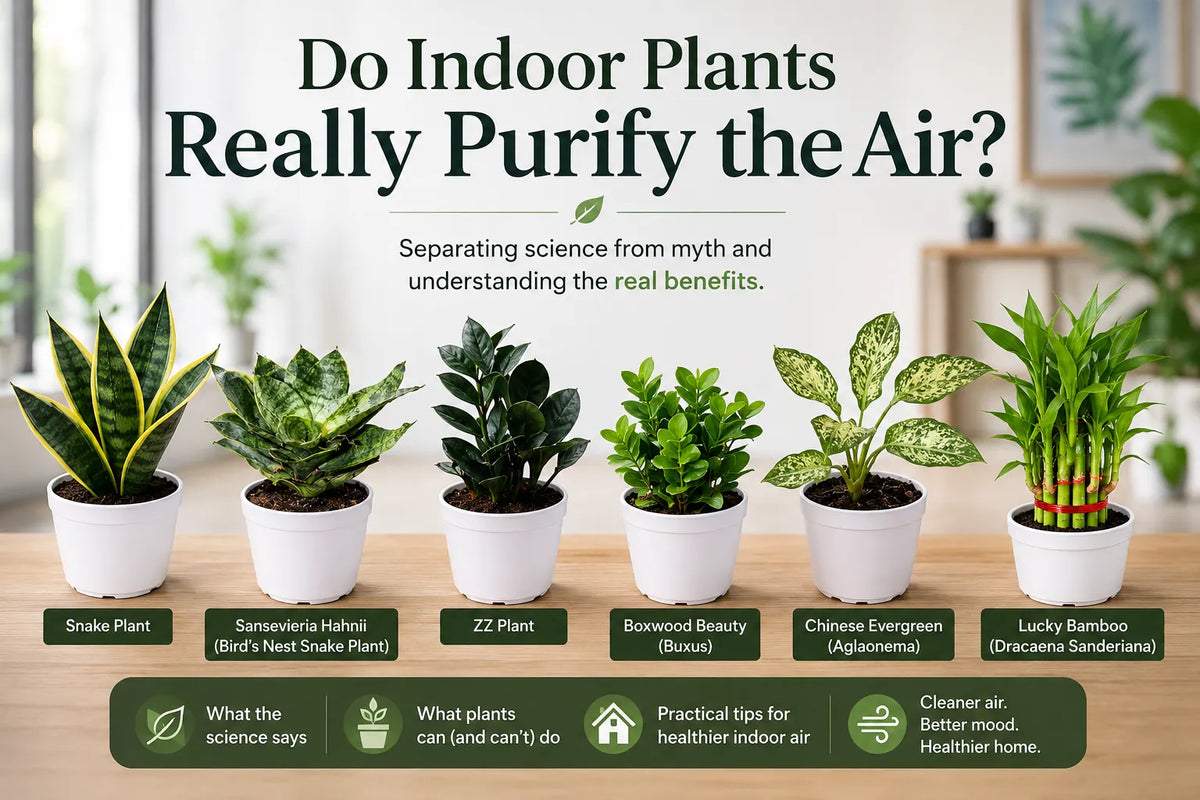
Do Indoor Plants Really Purify Air? What Science Says
Introduction
Indoor plants have become a common sight in homes and offices across the world, and it's easy to see why. They add life to a space and genuinely make it feel better to be in. But beyond looks, plants have also built a reputation as natural air cleaners — something you'll hear repeated in gardening content, wellness blogs, and product descriptions almost everywhere you look.
But how much of that is actually backed by science? Can indoor plants replace an air purifier? Or has the idea been stretched a bit too far over the years?
This article looks at what the research really says — the study that started it all, what newer science has found since, and what indoor plants for home environments can honestly offer.
Where the Air-Purifying Claim Came From
Most of this conversation traces back to a NASA study published in 1989.
The research was originally aimed at finding ways to maintain clean air inside sealed space stations. Scientists placed common houseplants in controlled chambers and measured whether they could draw down levels of certain chemical pollutants. Several plants did show the ability to reduce concentrations of:
- Benzene
- Formaldehyde
- Trichloroethylene
- Xylene
- Ammonia
Spider Plant, Peace Lily, Snake Plant, Golden Pothos, and English Ivy were among the plants that showed promising results.
The findings caught public attention quickly. Over time, the message simplified into something most people now take as common knowledge — that keeping houseplants indoors leads to cleaner air. The nuance of a sealed lab chamber got lost along the way.
What's Actually Floating Around in Indoor Air
Before looking at what plants can do, it helps to understand what they'd be up against.
Volatile Organic Compounds (VOCs) are chemical gases that release from everyday materials — paints, adhesives, synthetic carpets, plywood, cleaning products, and even some air fresheners. Regular exposure can lead to headaches, dizziness, and irritation of the eyes and respiratory system.
Carbon dioxide builds up naturally whenever people are breathing and cooking in an enclosed space. Without enough air movement, levels rise and people often feel dull or fatigued without knowing why.
Particulate matter — dust, pollen, pet dander, smoke — stays suspended in the air and affects breathing, especially for anyone with asthma or allergies.
Mold spores develop in damp, poorly ventilated corners and quietly worsen air quality over time.
How Plants Actually Interact With Indoor Air
Plants do have some real interaction with the air around them — through a few different pathways.
Leaf surfaces contain tiny pores called stomata that take in gases during normal plant function. Some chemical pollutants enter through these pores and get processed within the plant's tissue.
The soil plays a role too — and this part often gets overlooked. Microorganisms living in the root zone are actually quite effective at breaking down certain organic compounds, sometimes more so than the plant leaves themselves. The two work together.
Through photosynthesis, plants absorb carbon dioxide and produce oxygen. This is real, though the contribution of a few pots in a room is modest rather than transformative.
Plants also release moisture through transpiration. In dry rooms — especially those running air conditioning for long hours — this can make the air feel noticeably more comfortable. This is one of the more practical and underappreciated benefits of keeping air purifying plants indoors.
What Newer Research Has Found
The NASA study was a useful starting point. But research since then has added important context.
The main issue is that lab conditions are very different from real living spaces. In an actual home or office, air is constantly moving — windows open, doors swing, ventilation systems run, and new pollutant sources come and go throughout the day. Whatever slow absorption a plant achieves gets diluted almost immediately.
A significant review published in the Journal of Exposure Science & Environmental Epidemiology in 2019 looked across the available body of research and reached a straightforward conclusion: plants do remove VOCs, but at a rate far too slow to make a measurable difference in a real room. Standard ventilation systems move and filter air at a pace that plants simply cannot match.
The numbers behind this are striking. To achieve pollutant removal comparable to basic mechanical ventilation, some estimates put the requirement at 100 to 1,000 plants per square metre of floor space. That's obviously not something any home can accommodate.
So Do Indoor Plants Improve Air Quality at All?
Yes — just not in the dramatic way often described.
Plants aren't going to replace a ventilation system or an air purifier. But they're not without value either. Realistic benefits include a small contribution to absorbing airborne compounds, modest humidity addition, and something less measurable but genuinely important — they make people feel better. Studies have linked indoor plants to reduced stress, improved focus, and a greater sense of calm. They also make a room more pleasant to spend time in, which has its own indirect effect on wellbeing.
Think of indoor plants as background contributors to a healthier space rather than active air-cleaning machines.
Plants Most Often Associated With Air Purification
Whether you're picking up plants locally or looking through indoor plants online, these are the varieties that come up most often in air quality research — and all happen to be practical choices for everyday indoor spaces.
Snake Plant is hard to kill, comfortable in low light, and carries out a form of photosynthesis through the night — making it a reasonable choice for a bedroom.
Spider Plant grows fast, asks for very little, and is forgiving enough for anyone just starting out with indoor plants.
Peace Lily is one of the few flowering plants that does well in ordinary indoor light. It's calm in appearance and easy enough to look after.
Golden Pothos is one of the most adaptable indoor plants around. It grows in almost any condition and is found in homes and workplaces for exactly that reason.
Areca Palm adds a warmer, tropical feel to a room and transpires actively — useful in dry environments.
Boston Fern contributes humidity and has a full, lush look. It needs a bit more care but suits the right space well.
Rubber Plant has broad, glossy leaves and settles comfortably into most indoor settings.
Conclusion
Indoor plants do have some effect on air quality — just a smaller one than many people expect. The NASA study that launched this idea was real and genuinely interesting, but it was conducted under conditions that don't reflect how most of us actually live.
What plants are genuinely good at is making indoor spaces feel healthier and more pleasant — reducing stress, adding visual warmth, connecting us to something natural. Those benefits are real, even if they're harder to measure than parts-per-million of benzene.
A home full of indoor plants for home may not pass air quality tests the way a good purifier would. But it'll probably feel like a nicer place to live. And that counts for something.
Frequently Asked Questions (FAQ's)
1. Do indoor plants really clean the air?
To a small degree, yes. But in a normal home or office, the effect on overall air quality is limited. They're not a replacement for ventilation or an air purifier.
2. Which plant is best for air purification?
Snake Plant, Spider Plant, Peace Lily, Golden Pothos, and Areca Palm are the most frequently referenced in research and are all practical choices.
3. Can indoor plants reduce dust?
Leaves do collect some dust — but so does any surface. Plants aren't a real solution for dust. Regular cleaning does a much better job.
4. How many plants should I keep indoors?
For wellbeing and aesthetics, 5–15 healthy plants around the home is a good place to start.
5. Are indoor plants worth keeping?
Absolutely. The decorative, psychological, and environmental value of indoor plants makes them well worth having — with or without the air-purifying reputation.
5 Benefits of Having Plants in the Office
Adenium (Desert Rose) Care Guide for Indian Climate
Related Posts

What Are the Best Indoor Plants for Low-Light Rooms?

What Are the Easiest Indoor Plants to Grow at Home?

Indoor Plant Care During Monsoon: A Complete Guide to Healthy Houseplants

How to Prevent Common Monsoon Plant Diseases

Root Rot in Plants: Signs, Causes, Treatment & Prevention

Best Fertilizers for Plants During the Rainy Season: What to Use & When

How to Water Plants During Monsoon Without Overwatering


